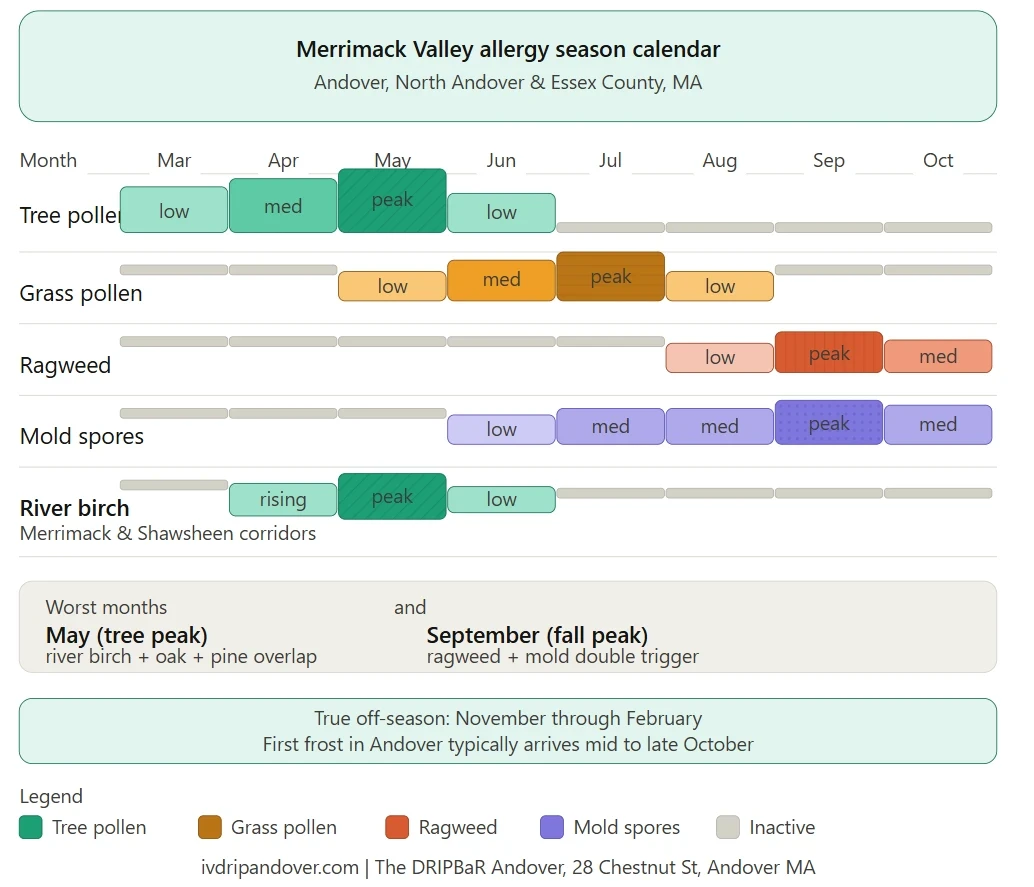
If you have ever walked the Shawsheen River trail in late April and come home with red eyes and a splitting sinus headache, you already know the answer. Andover's allergy season is not subtle. It starts in early March, layers pollen wave after pollen wave through summer, then hands off to ragweed and mold in the fall. By the time the first frost arrives in mid-October, residents of the Merrimack Valley have been navigating eight straight months of airborne triggers.
This calendar is not a generic Massachusetts guide. It is built for Andover, North Andover, Lawrence, Methuen, and the surrounding Essex County communities, where river corridors, open green space, and suburban tree canopy create a pollen environment that is meaningfully different from urban Boston. Each month below tells you what is active, how intense it tends to be, and who it hits hardest locally.
Why Andover's Allergy Season Hits Harder Than You Expect
The Merrimack River Effect
Andover and North Andover sit along two significant river corridors: the Merrimack River to the north and the Shawsheen River running directly through town. A third waterway, Cochichewick Brook, drains Lake Cochichewick in North Andover into the Merrimack. These riparian corridors are the native habitat of river birch (Betula nigra), one of the most potent spring allergens in the region.
Unlike paper birch, which grows in upland forests farther from homes, river birch grows exactly where Andover and North Andover residents walk, run, and cycle. The trails along the Shawsheen, the paths near Pomps Pond, the green corridors behind neighborhoods off River Road, and all of these put people in close and repeated contact with river birch pollen during its peak release window in late April and May. Boston's urban landscape dilutes pollen with concrete and building density. Andover does not have that buffer.
On top of the river corridors, Harold Parker State Forest sits just south of North Andover, adding a significant wooded oak and pine source. The combination creates a sustained, multi-species pollen load that runs from the first warm days of March through the final ragweed counts of October.
A Season That Runs March Through October
Most people think of allergy season as a spring event. In the Merrimack Valley, it is nearly a year-round condition. Tree pollen begins in early March. Grass pollen follows in June. Ragweed arrives in mid-August and peaks in September. Mold spores from decaying leaves extend exposure well into October.
Climate trends in New England have pushed the start of the pollen season earlier and extended its tail end, adding weeks to the overall exposure window compared to historical norms. For residents who are sensitive to multiple allergen types, there is very little true off-season between March and the first hard frost.
Month-by-Month: The Merrimack Valley Allergy Calendar
March: The First Wave
Active allergens: Maple, elm, alder Intensity: Low to moderate, rising through the month
March is the quiet start of a long season. Maple and elm are the first trees to pollinate in the Merrimack Valley, releasing pollen before their leaves even open. Counts start low but spike suddenly on warm, windy days. Residents near wooded areas on the outskirts of Andover and along the Route 28 corridor may notice the first hints of congestion toward the end of the month. If you are already reaching for tissues in March, the months ahead will be harder.
April: Tree Pollen Builds
Active allergens: River birch, oak, ash, alder, maple Intensity: Moderate to high
April is when most Andover residents first hit a wall. River birch along the Merrimack and Shawsheen corridors becomes fully active. Oak begins releasing. Ash and alder overlap. The mornings are the worst, typically between 5am and 10am on dry, breezy days. If you commute into Boston on the Haverhill Line, you are starting the day outdoors during peak pollen hours at Lawrence Station or Andover Station, then spending an hour in a sealed train car where allergens accumulate on clothing.
May: The Peak Month
Active allergens: River birch, oak, pine, ash Intensity: Very high
May is the hardest month of the Andover allergy season. River birch, oak, and ash are all producing at full volume. Pine adds to the load. If you have noticed a yellow-green dust coating your car on Chestnut Street, settling on the tables outside downtown restaurants, or filming across the windowsills of your house, and that is pine pollen. It is visible, it is everywhere, and while allergists consider pine a relatively weak allergen, the sheer quantity of exposure it represents means sensitive individuals still suffer through it.
The overlap of river birch and oak in May creates the highest combined pollen counts of the year. Morning outdoor activity near the Shawsheen River or Harold Parker State Forest during this window carries a significant exposure risk. Many Andover residents who manage April reasonably well find themselves overwhelmed in the first two weeks of May.
June: Grass Takes Over
Active allergens: Timothy grass, perennial ryegrass, Kentucky bluegrass Intensity: Moderate to high
Tree pollen begins winding down in early June, but the season does not pause. Grass pollen steps in. The athletic fields at Andover High School, the town recreation parks, and the residential lawns throughout Essex County become the primary sources. Timothy and ryegrass are the most allergenic grasses in the region and peak from late May through early July.
If your symptoms ease slightly in June compared to May, this does not mean you have cleared the season. It often means your particular sensitivities align more with trees than grasses. For people sensitive to both, June offers no relief at all.
July: A Relative Lull, But Mold Rises
Active allergens: Residual grass pollen, mold spores beginning Intensity: Low to moderate overall; mold increasing
July brings the lowest pollen counts of the Merrimack Valley allergy season. Grass pollen tapers. Tree season has passed. For many allergy sufferers, this is the first genuine breathing room since March. However, summer heat and humidity along the Merrimack River corridor create conditions that accelerate mold growth. Shaded, damp areas around Harold Parker State Forest and along the river banks begin producing elevated mold spore counts in mid-to-late July. If you are mold-sensitive, July is not as clear as it appears.
August: Ragweed Arrives
Active allergens: Ragweed, mold Intensity: Moderate, climbing toward high by month's end
Ragweed begins pollinating around mid-August in Massachusetts. Essex County is not the heaviest ragweed zone in the state; the Pioneer Valley and Worcester County see higher counts, but ragweed pollen travels. A single plant can produce billions of pollen grains in a season, and those grains are light enough to drift hundreds of miles on the wind. This means ragweed from western Massachusetts affects Andover residents regardless of whether it is growing locally.
The second half of August is when a different subset of allergy sufferers, those who made it through spring and summer without significant symptoms, begin experiencing their worst weeks of the year.
September: The Double Hit
Active allergens: Ragweed at peak, heavy mold from falling leaves Intensity: High
September is the most difficult month for fall allergy sufferers in the Merrimack Valley. Ragweed peaks and runs alongside rising mold counts from early-fallen and rained-on leaves. Schools reopen, which brings children who have been outdoors back into enclosed spaces, spreading allergens onto surfaces and into air systems. Andover and North Andover residents with children in Phillips Academy or the local school districts notice this accumulation effect quickly.
People sensitive to both ragweed and mold face a genuine double-trigger situation through September. The immune system is being asked to respond to two different allergen families simultaneously, which drives fatigue and systemic inflammation far beyond what either allergen would cause alone.
October: Winding Down, Not Done
Active allergens: Mold spores from leaf piles, residual ragweed until first frost Intensity: Low to moderate
The first hard frost, which arrives in Andover sometime between mid and late October in a typical year, effectively ends the pollen season. Ragweed cannot survive frost. But mold does not need warmth in the same way. Wet, decomposing leaf piles throughout Andover's neighborhoods and parks continue generating mold spores through October and into early November. Raking triggers exposure by releasing spores that have settled into the leaf layer. If October is surprisingly difficult for you, mold is almost certainly the reason.
River Birch and Pine: The Merrimack Valley's Signature Allergens
Why River Birch Is Andover's Most Aggressive Spring Allergen
River birch (Betula nigra) is botanically classified as a riparian species, meaning it grows along riverbanks and pond shorelines rather than in upland forests. Native Plant Trust documentation confirms that the Merrimack River corridor and Essex County pond shorelines are among the recognized native sites for river birch in Massachusetts and New Hampshire.
This matters for Andover and North Andover residents because the tree is not tucked away in remote forest. It lines the water corridors that run through populated neighborhoods, and it produces fine, wind-dispersed pollen that travels easily into adjacent streets and yards.
There is one more thing worth knowing about river birch that most allergy resources do not mention. People sensitized to birch pollen often experience what allergists call oral allergy syndrome: a tingling or itching in the mouth and throat when eating raw apples, peaches, cherries, or almonds. This happens because the proteins in those foods closely resemble birch pollen proteins, and the immune system cross-reacts. If May is difficult for you and certain raw fruits cause oral irritation in the same season, birch pollen is likely the common thread.
Pine Pollen: Everywhere You Look
Pine pollen is the most visible allergen in the Merrimack Valley. The yellow-green dust that coats every horizontal surface in Andover in May is almost entirely pine. Cars, outdoor furniture, decks, the sidewalks along Main Street, all of it.
The frustrating reality is that pine pollen's visibility creates a perception problem. Most allergy specialists consider pine a weak allergen because the pollen grains are large and do not penetrate deeply into the respiratory tract the way birch or ragweed pollen does. But the volume of exposure is extraordinary. For individuals with any birch or grass sensitization who are also mildly reactive to pine, the combined load in May can be enough to push symptoms over the threshold. The visible dust is also psychologically difficult. Seeing your environment coated in pollen makes it hard to dismiss what your body is telling you.
How Allergy Season Drains More Than Your Sinuses
The Fatigue Nobody Talks About
When your immune system detects pollen, it releases histamine. Histamine causes the familiar symptoms: runny nose, watery eyes, congestion. But the immune response itself is physically costly. The body is running a sustained low-grade inflammatory reaction for weeks or months at a time, and that draws resources away from everything else. Energy production drops. Sleep quality suffers. Concentration becomes harder.
For Andover residents who are already managing the biological drain of a long commute on the Haverhill Line, with its disrupted sleep, elevated cortisol, and sedentary hours, and allergy fatigue lands on top of an already depleted system. The two conditions compound each other in ways that are hard to untangle. If you have read about how commuting affects your immune system and your energy, you will recognize the overlap.
Dehydration as an Allergy Multiplier
Allergy symptoms themselves dehydrate the body. Mucus production is water-intensive. Mouth breathing, which most congested people default to at night, accelerates fluid loss. Post-nasal drip continually moves fluid out of the sinuses. And antihistamine medications, while effective at reducing histamine activity, are also inherently drying: they reduce secretions across the board, including the moisture lining the airways.
When the body is even mildly dehydrated, mucus thickens. Thick mucus drains poorly, increasing sinus pressure and the risk of secondary sinus infections. It also makes the nasal passages more permeable to allergen particles, which worsens the immune response. The relationship between hydration and allergy severity is direct: the drier you are, the harder the symptoms hit. We have written about why proper hydration goes far beyond how much water you drink daily, and this connection is one of the clearest examples of that principle.
Why Antihistamines Are Not the Whole Answer
The Drowsiness Problem
Antihistamines work. They block histamine receptors and reduce the severity of the immune response to pollen. But they come with limitations that matter to people who have jobs, families, and commutes.
First-generation antihistamines like diphenhydramine, sold as Benadryl, cause significant sedation. That is partly the point when used as a sleep aid, but it is a problem at 7am before a workday. Second-generation antihistamines like cetirizine (Zyrtec) and fexofenadine (Allegra) are marketed as non-drowsy, and they are less sedating than first-generation options. But cetirizine in particular still causes meaningful drowsiness in a notable proportion of users, and many people find they need to rotate between medications as the season progresses because tolerance builds.
The result is that many Andover allergy sufferers are managing symptoms with medications that affect their alertness at work, their ability to drive comfortably, and their sleep quality at night, all while the underlying inflammation and dehydration are still running in the background.
What IV Therapy Actually Delivers
IV therapy addresses the dimensions of allergy burden that antihistamines do not touch.
Antihistamines block receptors. They do not replace depleted fluids, restore the nutrients the immune response has consumed, reduce systemic inflammation at the cellular level, or replenish the antioxidant reserves that histamine activity depletes.
If May is the month that breaks you every year, or September leaves you exhausted in ways that go beyond typical tiredness, IV therapy for allergy and sinus relief may be worth discussing with the team directly. Sessions run approximately 45 to 60 minutes. You leave the same day, without the fog that some oral medications bring.
When Does ALlergy Season Start in Andover, MA?
Allergy season in Andover typically begins in early March when maple and elm trees start producing pollen. From that point, the season runs continuously through October, when the first hard frost ends ragweed season. Tree pollen dominates March through May, grass pollen runs through June and early July, and ragweed plus mold define August through October.
What Trees Cause the Worst Allergies in the Merrimack Valley?
River birch is the most significant tree allergen specific to Andover and North Andover, given its native presence along the Merrimack River, Shawsheen River, and Essex County pond shorelines. Oak is a close second, producing heavy pollen loads in May. Maple and elm start the season in March and April. Ash contributes to the spring overlap as well.
Is River Birch Pollen Particularly Bad in North Andover?
Yes. River birch is native to riparian corridors including the Merrimack River and the pond shorelines of Essex County, and North Andover sits directly along those corridors with Lake Cochichewick and Cochichewick Brook draining into the Merrimack. Residents who walk or exercise near these waterways during late April and May are getting some of the highest river birch exposure in the region.
How Long Does Ragweed Season Last in Massachusetts?
Ragweed typically begins pollinating around mid-August in Massachusetts and continues until the first hard frost, which arrives in Andover between mid and late October in most years. The peak is September. This gives ragweed roughly six to eight weeks of active season, with the highest counts in the final weeks of August and throughout September.
Can IV Therapy Jelp with Seasonal Allergy Symptoms?
IV therapy is not a treatment for allergies, and it does not replace antihistamines or other medications prescribed by a physician. What it does is address the secondary burdens that allergy season places on the body: dehydration from mucus production and mouth breathing, nutrient depletion from the sustained immune response, systemic inflammation driven by repeated histamine activity, and fatigue from running an immune response for weeks at a time.