Ascorbic acid is one of the most researched molecules in human nutrition. It shows up on supplement labels, skincare serums, IV therapy menus, and clinical trials in oncology, all at the same time. That range of appearances can make it confusing to figure out what ascorbic acid actually does, whether the form or dose you're using matters, and which claims are backed by real evidence. This guide covers all of it: the biochemistry, the food sources, the skincare science, the clinical applications, the side effects, and the questions people search most often.
What Is Ascorbic Acid?
Ascorbic acid is the chemical name for vitamin C. The two terms refer to the same molecule. When you see "ascorbic acid" on a supplement or ingredient label, it means vitamin C in its purest form.
Vitamin C is an essential nutrient, meaning the human body cannot synthesize it. Most animals can produce vitamin C internally from glucose, but humans lack the enzyme L-gulonolactone oxidase, which is the final step in that biosynthetic pathway. This makes dietary intake non-negotiable for maintaining adequate levels.
Key identifiers:
Chemical name: L-ascorbic acid (the biologically active form)
Also written as: ascorbic acid, vitamin C, L-ascorbate
Molecular formula: C₆H₈O₆
CAS Number: 50-81-7
Molecular weight: 176.12 g/mol
Solubility: Water-soluble; not stored in fat tissue
Classification: Water-soluble vitamin, essential micronutrient, antioxidant
The "L" in L-ascorbic acid refers to the stereochemical configuration of the molecule. The L-form is the biologically active enantiomer. D-ascorbic acid exists but has no significant vitamin activity in humans. When you see "L-ascorbic acid" on a serum or supplement label, this is not a marketing distinction; it is the chemically accurate designation for the form your body actually uses.
Ascorbic Acid Formula and Structure
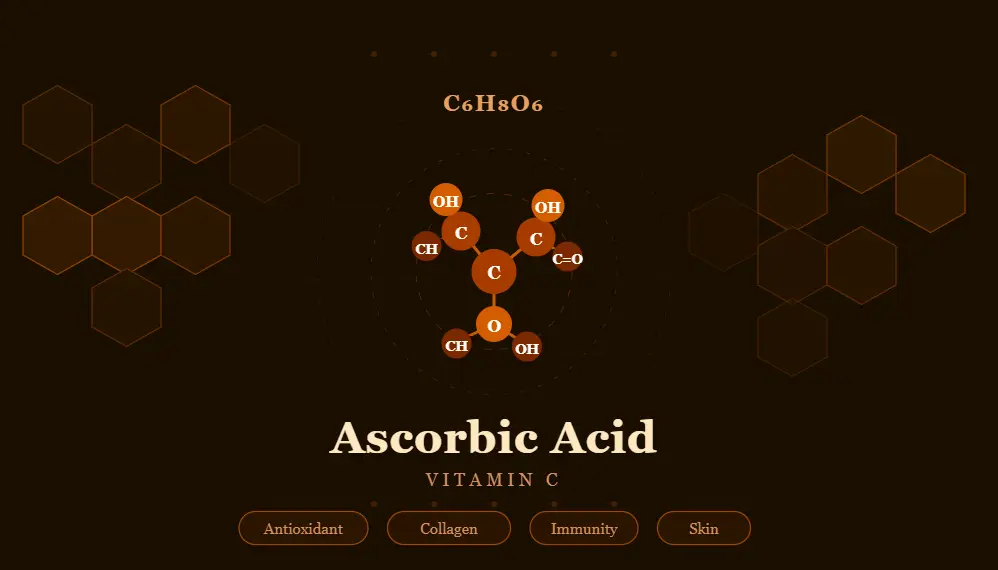
The molecular formula of ascorbic acid is C₆H₈O₆. Its structure is a six-carbon lactone ring containing two adjacent enol groups (-OH attached to a double bond). This enediol structure is what gives ascorbic acid its antioxidant activity: it readily donates electrons (and hydrogen atoms) to neutralize reactive oxygen species (ROS), becoming oxidized to dehydroascorbic acid (DHA) in the process. DHA can be enzymatically reduced back to ascorbic acid inside cells, completing a redox cycle.
This redox cycling capacity is central to understanding why ascorbic acid behaves differently from antioxidants that are simply consumed upon neutralizing a free radical. Ascorbic acid can donate electrons, be regenerated, and donate again. Glutathione is one of the molecules that participates in regenerating oxidized ascorbate back to its active form, which is one reason the two are frequently studied and used together.
Ascorbic Acid Rich Foods: Where Vitamin C Actually Comes From
The assumption that citrus fruits are the definitive source of vitamin C is only partially correct. Several plant foods contain considerably higher concentrations of ascorbic acid per serving.
Highest ascorbic acid content by food source (approximate values per 100g):
Food | Ascorbic Acid (mg/100g) |
Kakadu plum (Terminalia ferdinandiana) | 1,000 to 5,300 |
Acerola cherry | 1,000 to 1,677 |
Camu camu | 880 to 2,994 |
Guava | 228 |
Yellow bell pepper | 183 |
Red bell pepper | 128 |
Kiwifruit | 93 |
Broccoli (raw) | 89 |
Brussels sprouts | 85 |
Kale | 82 |
Strawberries | 59 |
Orange | 53 |
Lemon | 53 |
Grapefruit | 32 |
Tomato | 14 |
A few practical observations from this data. Bell peppers, particularly yellow and red, contain two to three times more ascorbic acid per gram than oranges, yet they rarely appear in conversations about vitamin C intake. Broccoli is a more concentrated source than citrus on a gram-for-gram basis. Cooking reduces ascorbic acid content significantly because it is heat-labile and water-soluble; boiling vegetables can destroy 50 to 80% of their vitamin C content.
Dietary ascorbic acid from food is generally better absorbed than many people assume. At typical dietary intake levels (30 to 180 mg/day), absorption rates are 70 to 90%. The challenge arises at higher supplemental doses, where absorption efficiency drops sharply.
What Does Ascorbic Acid Do in the Body?
1. Antioxidant Defense
Ascorbic acid is a potent water-soluble antioxidant. It neutralizes ROS including superoxide radicals, hydroxyl radicals, and singlet oxygen in aqueous environments (inside cells and in the bloodstream). Because it is water-soluble rather than fat-soluble, it operates in different compartments than antioxidants like Vitamin E. The two work synergistically: ascorbic acid can regenerate oxidized Vitamin E at the cell membrane surface, effectively extending Vitamin E's protective capacity.
2. Collagen Synthesis: The Core Structural Role
Ascorbic acid is an essential cofactor for two enzymes in collagen biosynthesis: prolyl hydroxylase and lysyl hydroxylase. These enzymes hydroxylate proline and lysine residues in procollagen chains. Hydroxylation of these residues is structurally required for the stable triple-helix conformation that makes collagen mechanically strong. Without adequate ascorbic acid, these hydroxylation reactions slow, collagen structure becomes unstable, and existing collagen breaks down faster than it is replaced. This is the molecular basis of scurvy, the clinical syndrome of vitamin C deficiency, which is characterized by impaired wound healing, bruising, and weakened connective tissue throughout the body.
Beyond deficiency correction, ascorbic acid also stimulates collagen gene expression at the transcriptional level, meaning it does not merely support collagen structure but actively promotes collagen production in fibroblasts. This dual role, both as a cofactor for collagen enzymes and as a stimulator of collagen gene expression, underpins much of the clinical evidence around wound healing, skin aging, and tissue repair.
3. Immune Modulation
Ascorbic acid accumulates in immune cells at concentrations 10 to 100 times higher than plasma levels, strongly suggesting an active functional role rather than passive distribution. Specific documented effects include:
Supporting neutrophil chemotaxis and phagocytosis
Protecting immune cells from oxidative damage generated during pathogen killing
Modulating cytokine production
Supporting the proliferation and differentiation of T-lymphocytes and B-lymphocytes
Enhancing natural killer (NK) cell activity
The immune-vitamin C relationship is bidirectional. Infection depletes plasma ascorbic acid rapidly, and supplementation during acute illness has been studied as a way to maintain immune function under oxidative stress.
4. Iron Absorption Enhancement
Ascorbic acid significantly enhances the absorption of non-heme iron, the form found in plant foods. It does this by reducing ferric iron (Fe³+) to ferrous iron (Fe²+), which is more soluble at the intestinal pH and better absorbed via the DMT1 transporter. Consuming ascorbic acid with plant-based iron sources can increase iron absorption by up to three to six times. This has direct relevance for people with plant-based diets or iron deficiency anemia.
5. Neurotransmitter and Hormone Synthesis
Ascorbic acid is a cofactor for dopamine beta-hydroxylase, the enzyme that converts dopamine to norepinephrine. It is also required for the synthesis of carnitine (which is involved in fatty acid transport into mitochondria) and for the amidation of neuropeptides including oxytocin and vasopressin. These roles are less commonly discussed but illustrate that ascorbic acid's functions extend well beyond antioxidant activity and collagen support.
Ascorbic Acid for Skin: What the Evidence Actually Shows
Topical L-Ascorbic Acid Serum
The science of topical vitamin C is more nuanced than most product marketing suggests. The critical variables are form, concentration, pH, and stability.
Form matters. L-ascorbic acid (pure vitamin C) is the only form with robust peer-reviewed clinical evidence for antioxidant activity and collagen synthesis stimulation in the skin. Many products labeled "vitamin C" use derivatives such as ascorbyl glucoside, ascorbyl palmitate, magnesium ascorbyl phosphate, or sodium ascorbyl phosphate. These are more stable and tolerate a wider pH range, but they require enzymatic conversion to L-ascorbic acid inside the skin before becoming active. The evidence base for the derivatives is weaker than for pure L-ascorbic acid.
pH determines whether it works. L-ascorbic acid must penetrate the stratum corneum to reach the dermis where collagen synthesis occurs. For this penetration to happen, the molecule must remain predominantly non-ionized, which requires an acidic environment. Research published in the Journal of the American Academy of Dermatology established that effective L-ascorbic acid penetration requires a formulation pH below 3.5. A product with a high concentration of ascorbic acid formulated at pH 5.0 or above will not deliver the same dermal benefit; most of the active ingredient stays on the skin surface.
Concentration has a ceiling. Clinical evidence for measurable effects on photoaging, hyperpigmentation, and skin firmness is concentrated in the 10% to 20% concentration range. Below 8%, antioxidant surface protection is present but collagen stimulation effects are minimal. Above 20%, dermal absorption plateaus while irritation risk increases with no proportional benefit gain.
What topical L-ascorbic acid has evidence for:
Inhibiting melanin production via tyrosinase inhibition, which addresses hyperpigmentation and uneven skin tone
Stimulating collagen synthesis in dermal fibroblasts
Reducing markers of photoaging (fine lines, roughness)
Providing photoprotection by neutralizing ROS generated by UV exposure (this is not a replacement for sunscreen; it works in addition to it)
Reducing post-inflammatory hyperpigmentation
The stability problem. L-ascorbic acid oxidizes in the presence of light, heat, air, and water, turning yellow and then brown as it degrades. An oxidized vitamin C serum has diminished efficacy and, at advanced oxidation stages, may generate pro-oxidant byproducts. Proper storage (dark, cool, airtight packaging) and checking that a product has not turned noticeably orange or brown before use matter more than most people realize.
Ascorbic Acid for Skin Systemically
Systemic ascorbic acid reaches the skin through the bloodstream and contributes to the same mechanisms: antioxidant defense in the dermis, cofactor activity for collagen synthesis, and protection against UV-induced oxidative damage. The bioavailability route is fundamentally different from topical application, and both approaches address skin health through different mechanisms that can complement each other.
Ascorbic Acid Supplement: Dosage, Forms, and Bioavailability
What Form Should You Take?
The most common oral forms are plain ascorbic acid, sodium ascorbate, calcium ascorbate, and "buffered" vitamin C blends. Sodium and calcium ascorbate are less acidic and better tolerated by people who experience GI upset with straight ascorbic acid at higher doses. The ascorbate ion is the same biologically active form regardless of whether it arrives as ascorbic acid or a salt; the difference is in tolerability, not in clinical activity.
Liposomal vitamin C uses phospholipid encapsulation to improve absorption and may achieve higher plasma levels than standard oral ascorbic acid, though large-scale clinical trials establishing a consistent absorption advantage over standard oral forms are limited.
Ascorbic Acid Dosage Per Day: What the Data Shows
Recommended Dietary Allowances (RDA) established by the NIH:
Population | RDA |
Adult men | 90 mg/day |
Adult women | 75 mg/day |
Pregnant women | 85 mg/day |
Breastfeeding women | 120 mg/day |
Smokers (all adults) | +35 mg above standard RDA |
Tolerable Upper Intake Level (UL): 2,000 mg/day for adults. Doses above this threshold are associated with increased risk of GI side effects and kidney stone formation.
The absorption ceiling is real. Oral ascorbic acid absorption is concentration-dependent and non-linear. At doses of 200 mg/day or below, nearly 100% of ingested ascorbic acid is absorbed. At 1,000 mg/day, absorption drops to approximately 50%. At 12,000 mg/day, only about 16% is absorbed; the rest is excreted in urine, which is why very high oral doses do not produce proportionally higher plasma concentrations. This absorption ceiling is a fundamental pharmacokinetic limitation of the oral route that distinguishes it from intravenous delivery.
Common supplementation ranges in practice:
Goal | Typical Daily Dose | Notes |
General health maintenance | 200 to 500 mg/day | Near-complete absorption |
Immune support during illness | 500 to 1,000 mg/day | Divided doses improve absorption |
Antioxidant / anti-aging support | 500 to 1,000 mg/day | Take with meals to reduce GI effects |
Collagen support (with food) | 500 mg before or with collagen-rich meals | Practical for connective tissue goals |
Clinical / therapeutic range | Above 1,000 mg/day | Medical supervision recommended |
Ascorbic Acid With Zinc: Does the Combination Make Sense?
Ascorbic acid and zinc are frequently combined in immune-support formulations, and there is a biochemical rationale for this pairing beyond marketing convenience.
Ascorbic acid enhances zinc absorption in the intestines. Zinc, in turn, helps stabilize ascorbic acid in the body. Both nutrients independently support immune cell function: zinc is a cofactor for over 200 enzymes and is directly required for T-lymphocyte and NK cell activity; ascorbic acid supports the same cell types through different mechanisms. The combination addresses immune defense from two distinct biochemical angles simultaneously.
One practical consideration: very high doses of zinc (above approximately 40 mg/day) can actually inhibit copper absorption, so zinc supplementation at therapeutic doses should not be open-ended. At standard immune-support dosing (10 to 25 mg zinc with 500 to 1,000 mg ascorbic acid), the pairing is well-supported and widely used.
If you are considering intravenous vitamin C alongside zinc, the full IV service at IV Drip Andover includes both ascorbic acid and zinc options that can be combined within personalized protocols designed by licensed nurses.
Ascorbic Acid IV Infusion: Why Delivery Method Changes Everything
The primary clinical argument for intravenous ascorbic acid comes down to a single pharmacological reality: the oral absorption ceiling does not apply to IV delivery. While oral intake is limited by digestive transporters, understanding the specific vitamin C bioavailability differences between these routes is essential for anyone seeking therapeutic plasma levels
When ascorbic acid is given orally, plasma concentrations plateau at approximately 70 to 80 micromolar (µmol/L) regardless of dose because intestinal absorption mechanisms become saturated. Intravenous administration bypasses this ceiling entirely. Clinical studies have documented plasma ascorbic acid concentrations reaching 20,000 µmol/L or higher with high-dose IV infusion, levels that are pharmacologically impossible to achieve through oral supplementation.
This concentration difference is not merely academic. The biological effects of ascorbic acid at pharmacological concentrations (achieved only via IV) are distinct from those at nutritional concentrations (achievable orally). At very high plasma concentrations, ascorbic acid can act as a pro-oxidant in the extracellular space, particularly in environments with high iron levels, which is one mechanism studied in oncology research with high-dose IV vitamin C protocols.
For wellness applications, high-dose IV ascorbic acid is used for intensive antioxidant support, immune function, tissue recovery, and fatigue reduction in ways that simply cannot be replicated with oral supplementation. The high-dose Vitamin C IV therapy at IV Drip Andover delivers pharmaceutical-grade ascorbic acid intravenously under the supervision of registered nurses, in concentrations that oral supplementation cannot match.
Ascorbic Acid Side Effects: What You Should Know
Ascorbic acid has an excellent safety profile at standard nutritional doses. Most side effects are dose-dependent and reversible.
Common Side Effects at Higher Oral Doses
GI upset: Nausea, stomach cramps, and diarrhea are the most common complaints, typically appearing at doses above 1,000 mg/day. This is largely due to unabsorbed ascorbic acid in the colon. Switching to buffered forms (sodium or calcium ascorbate) or dividing doses across the day usually resolves this.
Loose stools: The dose that triggers loose stools (sometimes called "bowel tolerance") varies considerably between individuals and tends to increase during illness or high oxidative stress.
Ascorbic Acid and Kidney Stones
This is the most clinically significant concern associated with high-dose ascorbic acid supplementation and deserves a direct, evidence-based answer.
The mechanism: the body metabolizes a portion of ascorbic acid to oxalate, which is excreted in urine. Higher doses of ascorbic acid increase urinary oxalate excretion. Since calcium oxalate is the most common component of kidney stones, elevated urinary oxalate is a plausible risk factor.
The evidence: a 2013 prospective cohort study published in JAMA Internal Medicine found that supplemental ascorbic acid was associated with a roughly doubled risk of kidney stones in Swedish men who were regular supplement users. A subsequent meta-analysis confirmed the finding, with kidney stone incidence significantly higher in men taking ascorbic acid supplements compared to non-users (OR 1.62; 95% CI: 1.09 to 2.42). Importantly, the risk was significantly higher in men than women in this analysis.
What this means practically: the kidney stone risk is most relevant for people with a personal or family history of calcium oxalate kidney stones, individuals with high baseline urinary oxalate, and men taking supplemental ascorbic acid regularly at doses above 500 mg/day. The risk appears meaningfully lower from food-based vitamin C intake compared to supplemental forms. If you have a history of kidney stones, discuss ascorbic acid supplementation with a healthcare provider before starting or increasing doses.
Other Considerations
G6PD deficiency: People with glucose-6-phosphate dehydrogenase deficiency should avoid high-dose IV ascorbic acid; there are documented reports of hemolytic anemia at pharmacological concentrations in this population.
Iron overload: Because ascorbic acid enhances iron absorption and can mobilize stored iron, individuals with hemochromatosis or other iron overload conditions should use caution with high-dose supplementation.
Drug interactions: Ascorbic acid may affect the absorption or activity of certain chemotherapy drugs, estrogen-containing medications, and anticoagulants like warfarin. Anyone on prescription medications should discuss supplementation with their prescriber.
Rebound scurvy: Abruptly stopping very high-dose supplementation (several grams/day) may transiently reduce plasma levels below normal; tapering is recommended if discontinuing very high doses.
Key Takeaways
Ascorbic acid and vitamin C are the same molecule. The L-ascorbic acid designation specifies the biologically active form.
The molecular formula is C₆H₈O₆. Its enediol structure enables electron donation and regeneration, making it a recyclable antioxidant rather than one that is simply consumed.
Humans cannot synthesize ascorbic acid and must obtain it through diet or supplementation. Bell peppers, guava, broccoli, and kiwifruit are among the most concentrated food sources; citrus is reliable but not exceptional by concentration.
Its core biological roles include collagen cofactor activity (via prolyl and lysyl hydroxylase), water-soluble antioxidant defense, iron absorption enhancement, and immune cell support.
For topical skin use, L-ascorbic acid at 10 to 20% concentration and pH below 3.5 has the strongest clinical evidence. Stability and formulation quality matter as much as the concentration percentage on the label.
Oral bioavailability plateaus at approximately 200 mg/day. Doses above this are absorbed with declining efficiency. The absorption ceiling is why IV delivery produces fundamentally different plasma concentrations than oral supplementation.
Kidney stone risk from supplemental ascorbic acid is documented primarily in men at doses above 500 to 1,000 mg/day. The risk is significantly lower from food sources and in women.
The Tolerable Upper Intake Level for adults is 2,000 mg/day. Most GI side effects are dose-dependent and manageable by dividing doses or switching to buffered forms.
This content is for informational purposes only and does not constitute medical advice, diagnosis, or treatment. Consult a qualified healthcare provider before starting any supplement protocol, particularly if you have a history of kidney stones, G6PD deficiency, iron overload conditions, or are taking prescription medications.
What Is The Difference Between Ascorbic Acid And Vitamin C?
They are the same molecule. Ascorbic acid is the chemical name; vitamin C is the common nutritional name. When a supplement or food label lists either term, it is referring to the same compound. The designation L-ascorbic acid specifies the biologically active stereoisomer.
Is Ascorbic Acid The Same Thing As L-ascorbic Acid Serum?
Yes, in the context of skincare. "L-ascorbic acid serum" refers to a topical product containing pure L-ascorbic acid (vitamin C) formulated for skin application. The L-ascorbic acid designation signals that the product contains the biologically active form of vitamin C rather than a derivative.
What Foods Are Highest In Ascorbic Acid?
Bell peppers (especially yellow and red), guava, kiwifruit, broccoli, and Brussels sprouts are among the highest sources. Citrus fruits are reliable sources but are not the most concentrated. Cooking significantly reduces vitamin C content; raw or lightly cooked vegetables retain more.
How Much Ascorbic Acid Should I Take Per Day?
The RDA for adults is 75 to 90 mg/day. The Tolerable Upper Intake Level is 2,000 mg/day. For most healthy adults using ascorbic acid for antioxidant or general immune support, 200 to 500 mg/day is an evidence-supported range that achieves near-complete absorption without meaningful GI effects.
What Is The Difference Between Oral And IV Ascorbic Acid?
The key difference is plasma concentration. Oral supplementation plateaus at plasma levels around 70 to 80 µmol/L regardless of dose, due to intestinal absorption saturation. IV infusion bypasses this ceiling entirely, achieving plasma concentrations orders of magnitude higher. This distinction matters for therapeutic applications that require pharmacological rather than nutritional vitamin C levels.